

National Security
At the National Conservative Energy Summit in Boston last month, a panel featuring three retired military officers made the case that offshore wind is a national security asset, not a liability. Their argument rested on a simple point: scrutinized for years by the Pentagon and other military agencies, these projects represent valuable new critical energy infrastructure that advances the nation’s energy independence.
Dave Belote, a retired Air Force colonel who now runs the renewable energy consultancy Dare Strategies, was joined onstage by retired Navy Commander Kirk Lippold and John Szoka, a retired Army lieutenant colonel who leads the Conservative Energy Network. The three retired officers discussed how offshore wind projects are carefully planned to avoid national security risks; the benefits of training in and around offshore wind projects; the need for U.S. energy security; and the economic and competitive advantages of deploying offshore wind domestically.
Offshore wind’s impact on national security has been in the spotlight since five projects along the East Coast were ordered to stop work late last year. When the administration cited national security to justify the order, retired officials pushed back right away. Writing in the Hartford Courant, Cmdr. Lippold called it “a baseless and false narrative.” Vice Admiral Dennis McGinn, a former Assistant Secretary of the Navy who commanded naval operations across the Pacific, told AP News the concerns “doesn’t pass commonsense tests.”
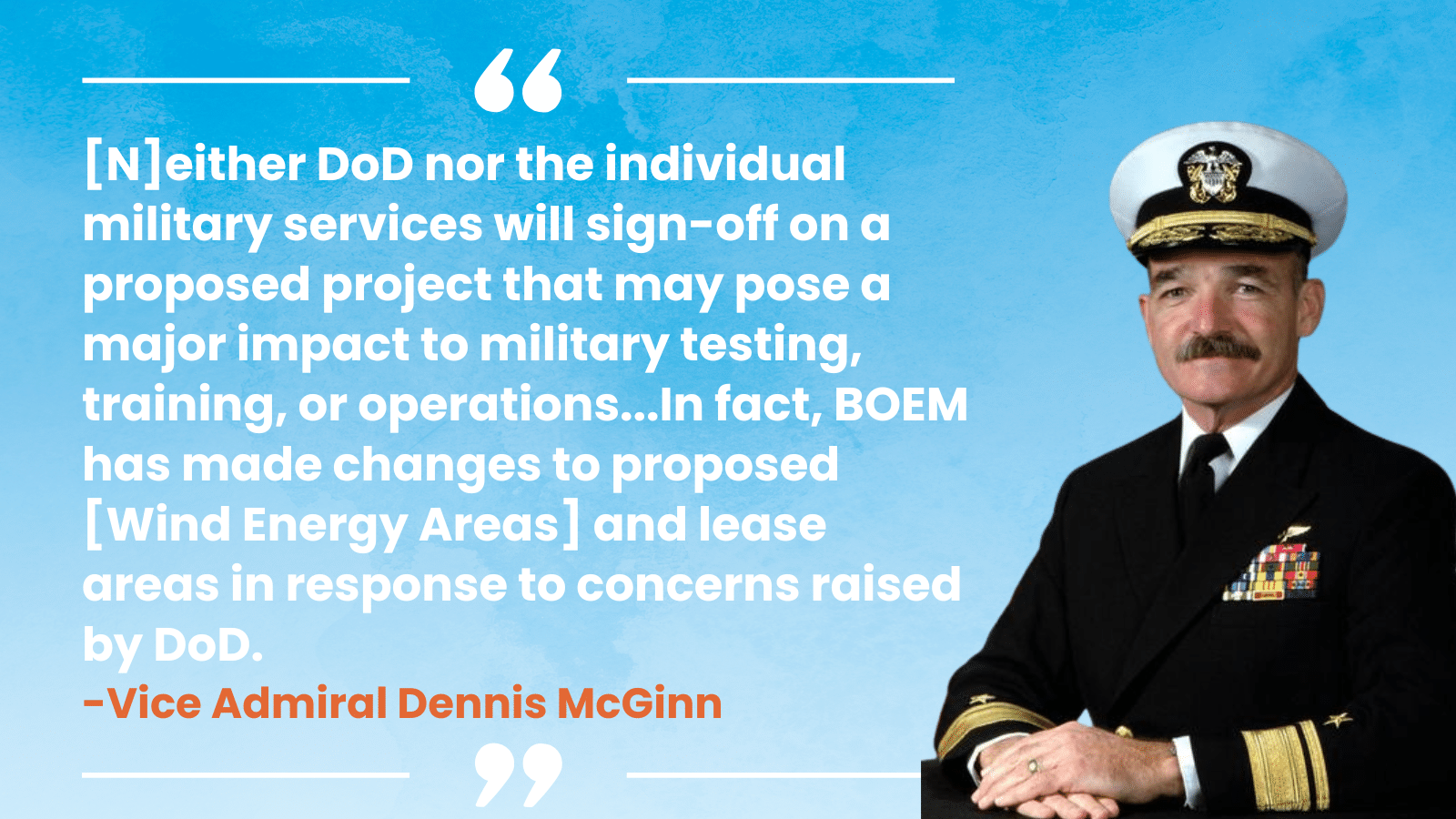
Vice Adm. McGinn’s skepticism wasn’t new. In a 2020 letter to BOEM on the Vineyard Wind environmental review, he wrote that he could vouch for the process from the inside: neither DoD nor “the individual military services will sign-off on a proposed project” that threatens military operations.
The administration’s claim that turbines could mask a swarm drone attack drew some of the sharpest pushback. Cmdr. Lippold called that argument “blowing smoke at the American people” in the Los Angeles Times, and told E&E News it sounded like the kind of overactive imagination that goes looking for a justification. Writing in Windpower Monthly, he pointed out that permits for the projects had followed years of review by the Coast Guard, the Naval Undersea Warfare Center, the Air Force, NORAD, the Army Corps of Engineers, and the FAA, with the Department of Defense consulted at every stage.
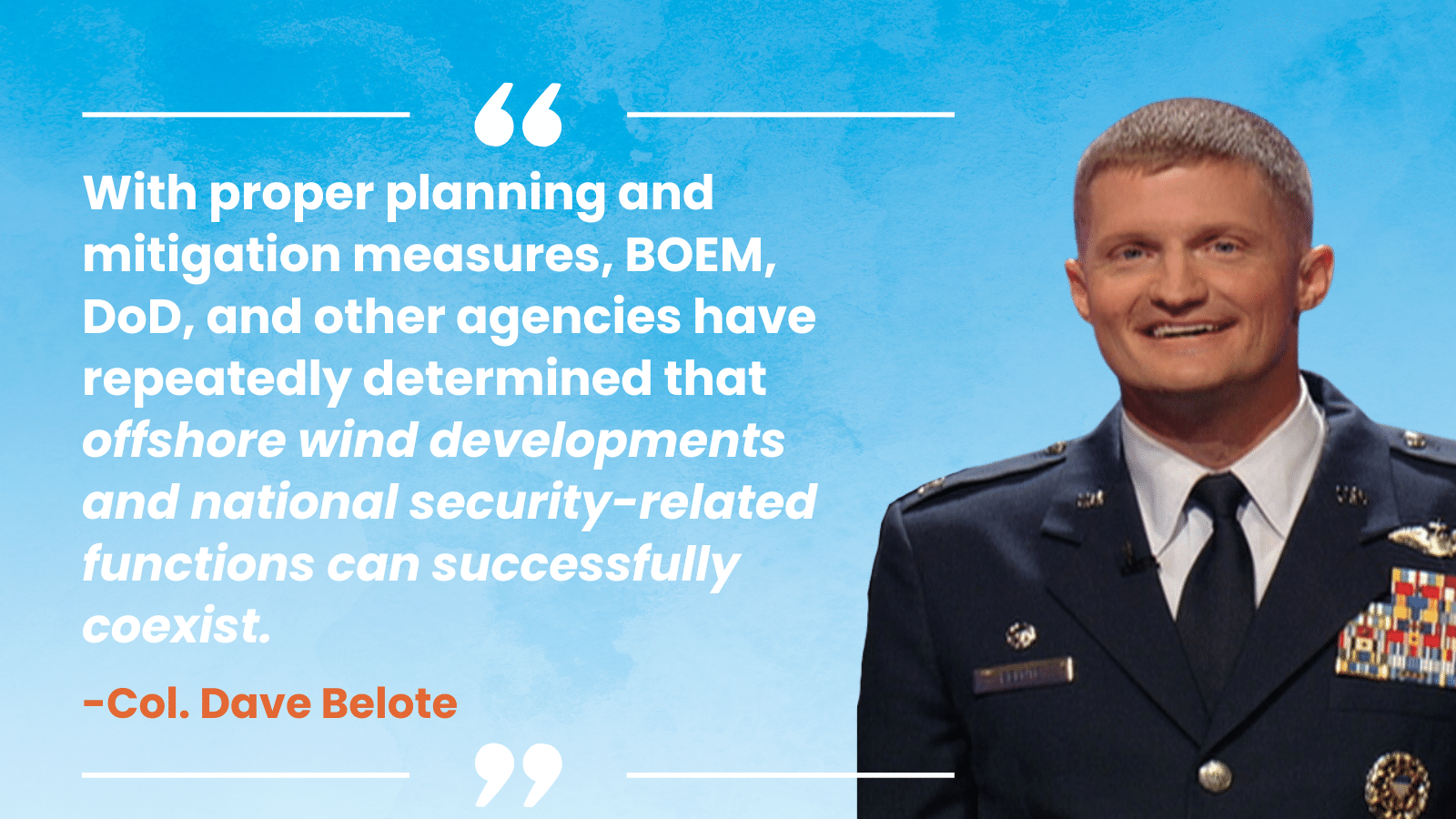
That same review process is the one Col. Belote described directly to a federal court. In a declaration filed on behalf of Vineyard Wind, he wrote that construction “presents negligible overall national security risk, and none with respect to radar interference.”
0.016%
The share of the total Atlantic continental shelf covered by the five offshore wind projects targeted by last year’s stop-work orders, according to Dave Belote — too small a footprint to plausibly compromise an entire coastline’s defenses.
At the Boston panel, the former officers contended that offshore wind projects can enhance, rather than hinder, military operations. Col. Belote and Cmdr. Lippold argued that offshore wind projects give the military a training ground it will need more of, not less. Radar operators need practice telling a spinning blade from a real threat, and submarine crews need practice navigating around turbine foundations.
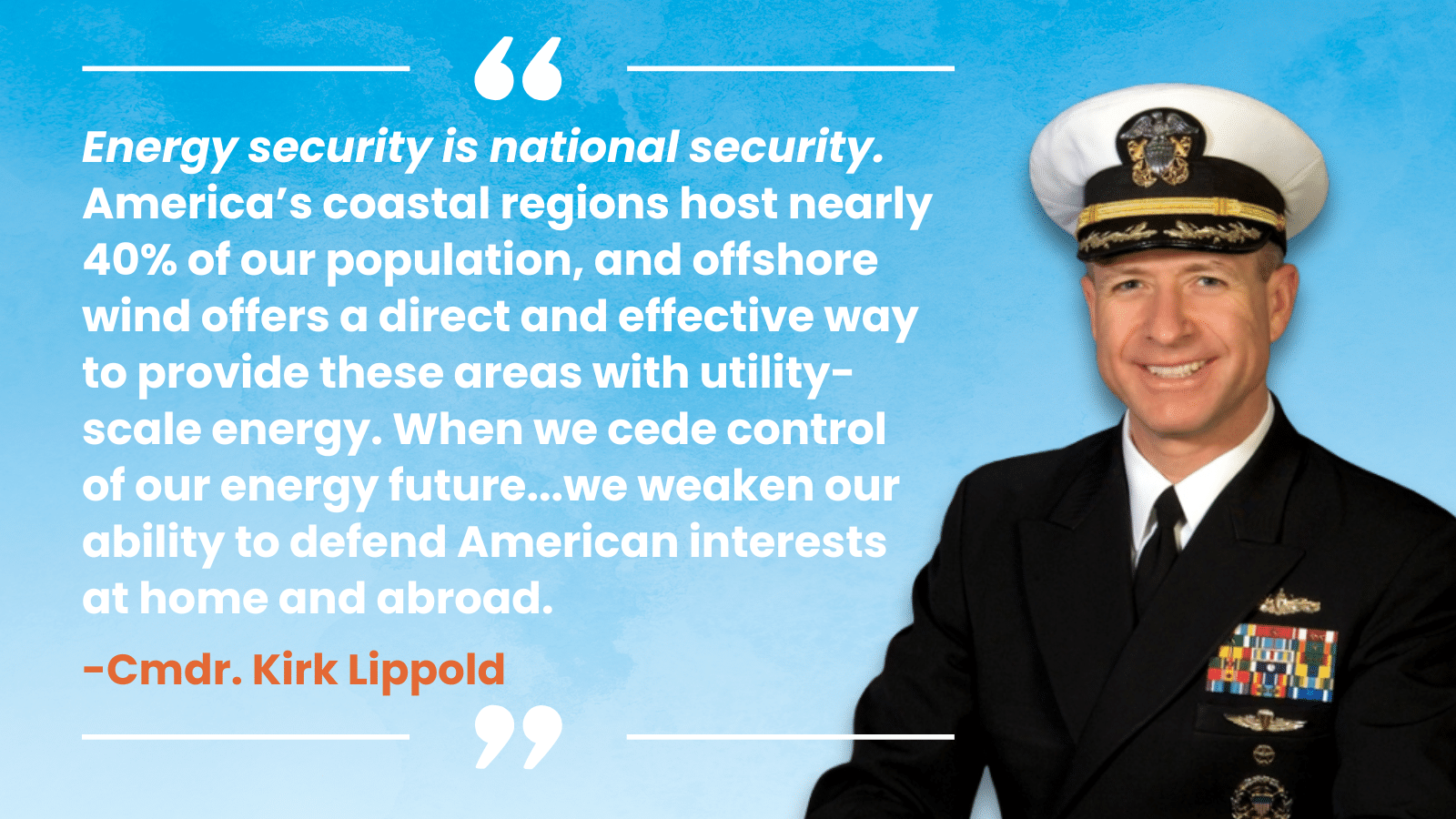
Cmdr. Lippold summed up the broader stakes last December, writing in the Providence Journal: “Energy security has always been national security.” In RealClearEnergy, he was still more direct, warning that ceding control of the country’s energy future to volatile markets or foreign rivals means “we weaken our ability to defend American interests at home and abroad.”
Back at the conference, Lt. Col. Szoka pointed out that a single offshore wind port carries the same regional economic weight as an auto manufacturing plant, a claim backed up by a new economic impact analysis of South Fork and Sunrise Wind.
So what happened with the stop-work orders? The courts granted each of the five projects an injunction allowing construction to continue while the cases make their way through court. Meanwhile, Revolution Wind, CVOW, and Vineyard Wind are no longer hypothetical, with each of the projects now sending power to the grid. They proved their worth in this past winter’s cold snaps, then carried the region through this summer’s heat waves. Sunrise Wind and Empire Wind are expected to follow suit next.
That reliability of those now working projects cements the case that Cmdr. Lippold and Vice Adm. McGinn were making from the start. A grid that holds up through a heat wave and a cold snap depends on having more than one kind of power available, and offshore wind is already proving it can carry that weight. The Pentagon cleared these projects for construction back when electrons were non-political. Let’s hope we manage to recapture that mindset before the progress of more valuable U.S. energy infrastructure is hampered.
Read More
• AP News: Trump cites national security to stop offshore wind development
• Los Angeles Times: Retired Navy commander on the administration’s radar interference claim
• Hartford Courant: Cmdr. Kirk Lippold on the Revolution Wind stop-work order
• Utility Dive: Coastal Virginia Offshore Wind begins delivering power