
America’s need for electricity is rising as data centers expand, manufacturing grows, and more of the economy becomes electrified. New research and real-world operating data suggest that offshore wind can make a meaningful contribution to grid reliability by delivering power during periods of high demand and helping address growing supply challenges.
Context
America needs more electricity
Demand is rising rapidly as data centers expand, manufacturing grows and more of the economy becomes electrified. In fact, according to the North American Electric Reliability Corporation (NERC), electricity demand is projected to grow at its fastest pace since 1995.
The challenge is that new electricity supply is not keeping pace.
|
120 GW
Projected growth in U.S. electricity demand this decade, driven by data centers, manufacturing, and electrification.
|
Source: NERC, 2025 Long-Term Reliability Assessment.
That growing gap between supply and demand creates a straightforward reliability problem: the grid needs significantly more power, and it needs resources that can deliver electricity when and where demand is greatest.
Recent analysis conducted by Charles River Associates (CRA) for Turn Forward’s Energy Research Exchange shows that offshore wind can be an important part of the solution.
The Data
Offshore wind delivers when the grid needs it
Not all sources of electricity contribute to reliability in the same way. Offshore wind stands out because it combines significant electricity production with a generation profile that aligns well with periods of grid stress.
Across the U.S. electricity markets CRA studied, offshore wind provides roughly twice the reliability contribution of solar and about 50% more than onshore wind, the strongest reliability contribution of any renewable technology examined. Offshore wind also produces more consistently, with a capacity factor of roughly 46%, compared with 37% for onshore wind and a median of 24% for solar.
Chart
Renewable energy capacity factors
Source: CRA analysis; U.S. Energy Information Administration.
And we have already seen that performance when electricity demand is high.
During a period of peak demand in New England on July 2, both Vineyard Wind off Massachusetts and Revolution Wind, serving Rhode Island and Connecticut, were generating electricity for the region. Their output added power to the grid during one of the most demanding periods of the summer.
Farther south, South Fork Wind also performed strongly throughout the July 1–4 heat wave. On July 2, when Long Island’s grid operator issued an alert amid high electricity demand, the project produced nearly 90% of its maximum output.
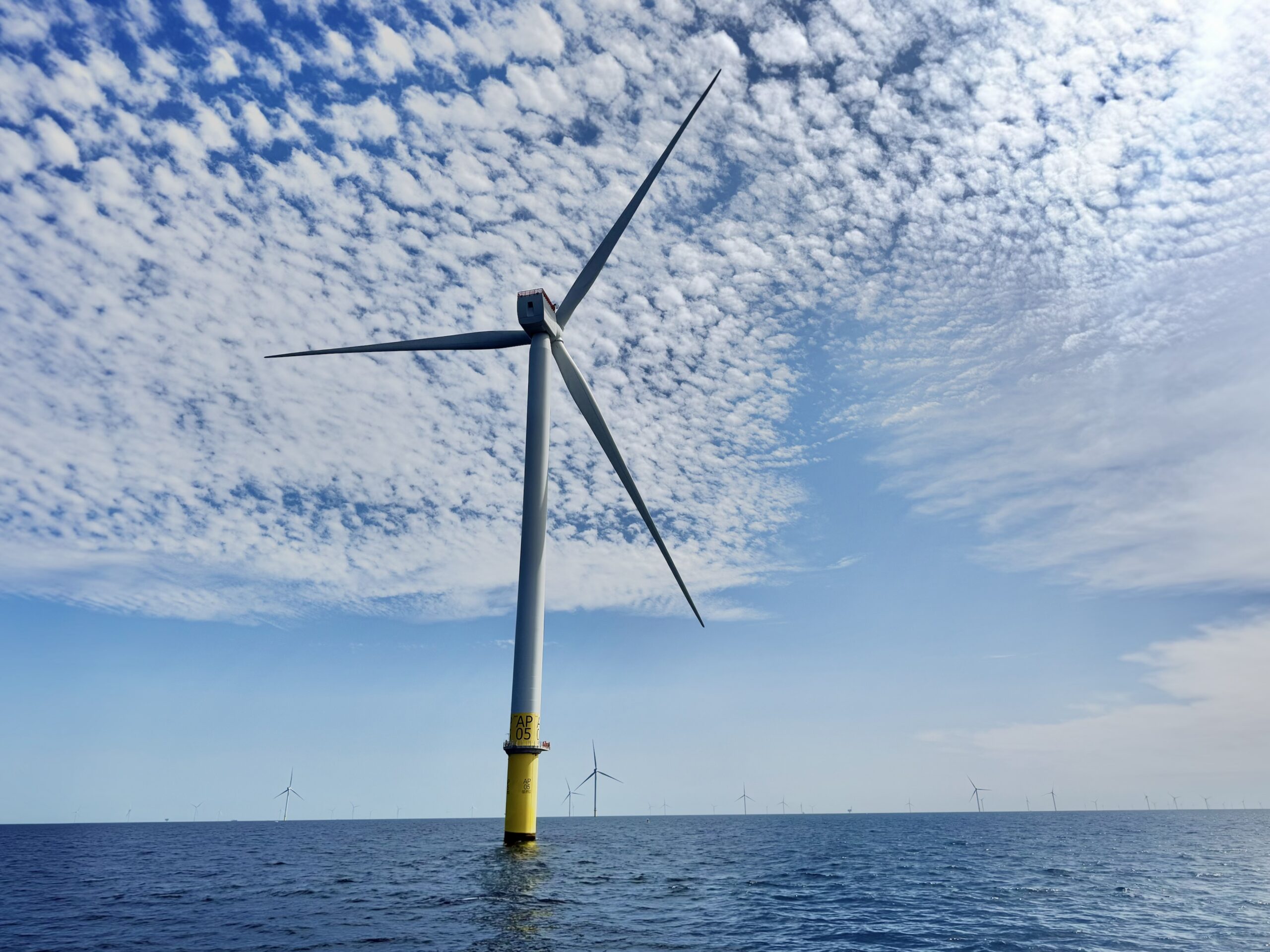
A turbine at South Fork Wind, off the coast of Long Island. The project was generating nearly full power on July 2, the same day New York’s grid operator warned that reserves were tightening.
Offshore wind also tends to produce more during winter months and evening hours. That is increasingly important as reliability risks shift toward colder months. In PJM, 87% of modeled reliability risk now occurs during the winter. Similarly in New England, winter peak electricity demand is growing three times faster than summer peak demand.
Chart
Reliability risk is shifting from summer to winter in New England and New York
Source: Charles River Associates, “Impacts of Offshore Wind on Reliability and Affordability in ISO-NE and NYISO,” December 2025.
Taken together, the evidence points to an important reliability advantage: offshore wind doesn’t simply add more electricity. It does so specifically when the grid is under the greatest pressure.
|
~90%
Share of its maximum output that South Fork Wind was generating on July 2, the same day Long Island’s grid operator warned that power reserves were tightening.
|
46.4%
South Fork’s originally projected average level of output over the course of a year.
|
Source: Ørsted, “Energy That Works: South Fork Wind” (2025); NYISO Energy Watch, July 2, 2026.
The Research
Without offshore wind, reliability risks grow
The value of offshore wind also becomes clear when looking at what happens when that power isn’t available.
In New York, CRA found that cancelling planned offshore wind without replacing it with other generation would increase blackout risk by roughly 25%, with the greatest risk concentrated in New York City and Long Island.
In PJM, where CRA projects a 7.8 GW capacity shortfall by 2033 (a gap between the power available for the grid to call upon and what it expects to need), Coastal Virginia Offshore Wind alone is expected to close approximately 936 MW of that gap. The analysis also found that tripling offshore wind investment could reduce the risk of forced power outages, what grid operators call load-shedding, by roughly 40%.
Different regions face different challenges, but the pattern is consistent: when electricity supplies are tight, offshore wind can strengthen the grid. Taking it away increases pressure on a system already struggling to keep pace with growing demand.
Chart
PJM’s reserve margin is falling short of its own target
Source: PJM Interconnection; Charles River Associates.
Bottom Line
The grid needs every resource available
There is no single resource that will meet all of America’s growing electricity needs.
But at a moment when demand is rising faster than supply, taking viable sources of new electricity off the table moves the grid in the wrong direction.
Offshore wind is a proven technology capable of producing significant amounts of electricity, with a generation profile that aligns particularly well with periods of growing grid stress.
The stakes are clear: we need more reliable power to meet growing demand, and offshore wind can help deliver it.
Reports
The Contribution of Offshore Wind to Grid Reliability and Resource Adequacy — CRA, November 2025
Impacts of Offshore Wind on Reliability and Affordability in ISO-NE and NYISO — CRA, December 2025
Offshore Wind Can Help Address PJM’s Growing Energy Challenge — CRA, 2026
Related Posts
3 Million Homes’ Worth of New Demand Is Coming
South Fork Wind Hit 90% Capacity Factor on the Hottest Day of the Summer (So Far)
PJM Needs Every Megawatt It Can Get
News
Here’s how offshore wind helped New England beat record heat — Canary Media, July 2026